
The Invention of Copper Engraving, from Nova Reperta
c. 1591
Medium
Engraving in black on ivory laid paper
Dimensions
Image/sheet, trimmed within platemark: 20.2 × 27.3 cm (8 × 10 3/4 in.)
Classification
engraving
Department
Prints and Drawings
Museum
Art Institute of Chicago
Accession Number
200659
Rights
Public Domain
About this artwork
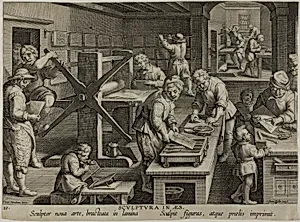
Joannes Stradanus’s image of an intaglio print shop includes plate engravers, roller-press printers, and fresh impressions drying on ropes in the background. The legend Sculptura in Aes implies that the engraving is being done on copper plates. The print is the nineteenth image in the artist’s New Discoveries series, which also included the European arrival in the Americas and the invention of book printing.
Art Historical Context
In the late 16th century, engraver Theodoor created *The Invention of Copper Engr*, a captivating plate from the *Nova Reperta* (Latin for "New Discoveries Designed by Jan van der Straet (Stradan), this engraving celebrates Renaissance innovations, with Galle's meticulous technique bringing to life the very process it depicts: a master engraver at work on a copper plate, surrounded by tools and apprentices. Printed in black ink on delicate ivory laid paper (20.2 × 27.3 cm), it exemplifies the fine detail possible with copper engraving, a breakthrough over coarser woodcuts. This self-referential image highlights copper engraving's pivotal role in the Northern Renaissance print revolution around 1591. Invented decades earlier, the method involved incising precise lines into a durable copper plate, allowing mass production of intricate images that spread knowledge, art, and ideas across Europe. Produced in Antwerp—a hub of printing innovation—the *Nova Reperta* series proudly showcased technological triumphs, blending artistry with proto-scientific wonder. Today, housed in the Art Institute of Chicago's Prints and Drawings department, this work invites us to marvel at how prints like this democratized art, influencing everything from book illustration to propaganda. A testament to human ingenuity, it reminds visitors that every great invention tells a story etched in history.