
The Japanese Footbridge
1899
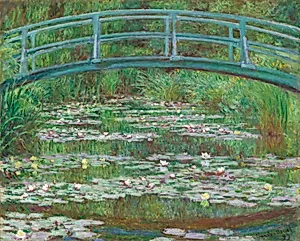
Medium
oil on canvas
Dimensions
overall: 81.3 x 101.6 cm (32 x 40 in.) framed: 101 x 120.7 x 7.6 cm (39 3/4 x 47 1/2 x 3 in.)
Classification
Painting
Department
CF
Museum
National Gallery of Art, Washington, D.C.
Credit
Gift of Victoria Nebeker Coberly, in memory of her son John W. Mudd, and Walter H. and Leonore Annenberg
Accession Number
1992.9.1
Rights
Public Domain
Art Historical Context
Claude Monet's *The Japanese Footbridge*1899) captures a serene moment in the artist's beloved garden at Giverny,. As a cornerstone of Impressionism, Monet revolutionized painting by emphasizing fleeting effects of light and color over precise detail. This oil on canvas work depicts the arched wooden bridge he had built over his lily pond, inspired by Japanese art—a passion that influenced many Western artists of the era. The intimate scale (81.3 x 101.6 cm) invites viewers into this private paradise, where Monet spent his later years immersed in nature. Monet's loose, vibrant brushstrokes masterfully convey the play of sunlight filtering through wisteria and leaves, blurring the line between water and sky. Oil on canvas allowed him to layer colors wet-into-wet, achieving luminous depth and atmospheric haze—hallmarks of his technique developed through en plein air painting. This piece is one of several versions he created, reflecting his obsessive exploration of the same motif under varying conditions. Now housed in the National Gallery of Art, Washington, D.C., thanks to a generous gift from Victoria Nebeker Coberly and the Annenbergs, it exemplifies Monet's enduring legacy. For visitors, it offers a window into fin-de-siècle escapism, blending personal vision with universal beauty.
About the Artist
Claude Monet · 1840–1926
Claude Monet, born Oscar-Claude Monet on November 14, 1840, in Paris and raised in Le Havre, Normandy, began his artistic journey as a successful teenage caricaturist. His formal training started at the Le Havre secondary school of the arts in 1851, where he received his first drawing lessons from Jacques-François Ochard. Around 1858, he met Eugène Boudin, who became his pivotal mentor, introducin...