
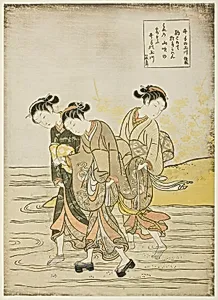
The Jewel River at Ide (Ide no Tamagawa), from an untitled series of Six Jewel Rivers
c. 1767
Medium
Color woodblock print; chuban
Dimensions
28 × 20.2 cm (11 × 7 15/16 in.)
Classification
woodblock print
Department
Arts of Asia
Museum
Art Institute of Chicago
Accession Number
20847
Rights
Public Domain
Art Historical Context
Suzuki Harunobu's *The Jewel River at Ide (Ide no Tamagawa)* created around 1767, is a delicate color woodblock print from an untitled series depicting Japan's legendary Six Jewel Rivers—poetic sites celebrated for their shimmering waters and romantic allure in classical literature. This chuban-sized work (28 × 20.2 cm) captures the serene beauty of Ide no Tamagawa, one of these revered rivers, evoking the elegance of Edo-period (1603–1868) Japan. Harunobu, a master of ukiyo-e ("pictures of the floating world"), pioneered full-color nishiki-e prints just two years earlier, making art accessible to a broader audience beyond elites. Harunobu's innovative technique involved multiple woodblocks inked with vibrant pigments, layered to produce subtle gradients and luminous effects that mimic moonlight on water or silk textures. His style blends refined realism with poetic idealism, often featuring graceful figures amid nature, reflecting ukiyo-e's focus on fleeting pleasures and beauty. Culturally, the Six Jewel Rivers series draws from waka poetry and folklore, symbolizing purity and transience. Printed during a booming urban culture in 18th-century Tokyo (then Edo), it exemplifies how woodblock prints democratized high art, influencing global aesthetics from Impressionism onward. A gem in the Art Institute of Chicago's Arts of Asia collection, it invites viewers to savor Japan's timeless harmony of landscape and lyricism.
About the Artist
Suzuki Harunobu · 1725–1770
Suzuki Harunobu (c. 1725-1770) was a Japanese ukiyo-e artist who revolutionized woodblock printing by developing nishiki-e—full-color prints using multiple woodblocks—in 1765. Before Harunobu, Japanese prints were limited to two or three colors; his innovation unleashed the entire artist's palette, transforming ukiyo-e into the vibrant art form that would later captivate Western artists from Manet...