
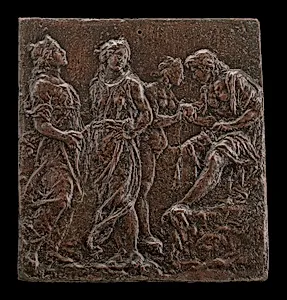
The Judgment of Paris
c. 1475/1485
Medium
bronze//Dark patina (black lacquer somewhat rubbed over rich reddish-brown bronze)
Dimensions
overall: 13.69 x 13.03 cm (5 3/8 x 5 1/8 in.) gross weight: 617.4 gr (1.361 lb.)
Classification
Sculpture
Department
CSD
Museum
National Gallery of Art, Washington, D.C.
Credit
Samuel H. Kress Collection
Accession Number
1957.14.140
Rights
Public Domain
Art Historical Context
The Judgment of Paris, a small bronze relief created by the versatile Sienese artist Francesco di Giorgio Martini around 1475–1485, captures a pivotal moment from Greek mythology. Paris, the Trojan prince, must decide which goddess—Juno, Minerva, or Venus—is the most beautiful, ultimately awarding the golden apple to Venus. This intimate work, measuring just over five inches across, reflects the Renaissance fascination with classical stories reinterpreted through a contemporary lens. Francesco di Giorgio, known for his work as an architect, engineer, and sculptor during the Italian Renaissance, brought a refined sense of composition and detail to the medium. The rich reddish-brown bronze, finished with a dark patina, evokes the prestige of ancient Roman artifacts while showcasing the technical mastery of casting and finishing that defined 15th-century Italian workshops. Such portable bronzes were often collected by educated patrons who admired both mythological narratives and the revival of classical forms. Housed in the National Gallery of Art’s Samuel H. Kress Collection, this sculpture offers visitors a tangible connection to the humanist interests of the Renaissance, where art served as both decoration and a bridge to antiquity. Its compact scale invites close viewing, revealing the artist’s skill in conveying drama within a modest format.
About the Artist
Francesco di Giorgio Martini · 1439–1501
Francesco di Giorgio Martini (1439–1501) was a quintessential Renaissance polymath from Siena, Italy, excelling as a painter, sculptor, architect, engineer, and theorist in the Sienese School tradition. Baptized on September 23, 1439, to a poultry dealer named Francesco Maurizio di Giorgio di Martino, his early life remains sparsely documented, with the first record of his artistic activity appear...