
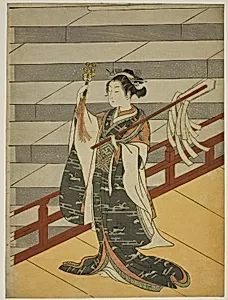
The Kagura Dancer
c. 1766
Medium
Color woodblock print; chuban
Dimensions
28.3 × 21 cm (11 1/8 × 8 1/4 in.)
Classification
woodblock print
Department
Arts of Asia
Museum
Art Institute of Chicago
Accession Number
20840
Rights
Public Domain
Art Historical Context
Suzuki Harunobu's *The Kagura Dancer (c. 1766) is a captivating color woodblock print from Japan's ukiyo-e tradition, showcasing the artist's pioneering role in full-color printing Measuring 28.3 × 21 cm in the chuban format—a compact size ideal for affordable, intimate viewing—this work captures a graceful figure mid-performance in kagura, a sacredinto ritual dance performed to entertain the gods. Harunobu, active during the Edo period (1603–1868), revolutionized printmaking around 1765 by introducing *nishiki-e* (brocade pictures), layering vibrant hues through multiple carved woodblocks for unprecedented depth and realism. The print's artistic significance lies in Harunobu's mastery of subtle gradations and delicate lines, evoking the dancer's flowing robes and poised elegance against a minimalist background. This technique not only highlighted feminine beauty—a hallmark of *bijin-ga* (pictures of beautiful women)—but also democratized art, making sophisticated imagery accessible beyond elite patrons. Culturally, it reflects Edo Japan's fascination with theater and festivals, blending reverence for tradition with the era's playful urban spirit. Housed in the Art Institute of Chicago's Arts of Asia department, *The Kagura Dancer* invites visitors to appreciate how Harunobu's innovations bridged spirituality and sensuality, influencing generations of printmakers like Utamaro and Hokusai.
About the Artist
Suzuki Harunobu · 1725–1770
Suzuki Harunobu (c. 1725-1770) was a Japanese ukiyo-e artist who revolutionized woodblock printing by developing nishiki-e—full-color prints using multiple woodblocks—in 1765. Before Harunobu, Japanese prints were limited to two or three colors; his innovation unleashed the entire artist's palette, transforming ukiyo-e into the vibrant art form that would later captivate Western artists from Manet...