
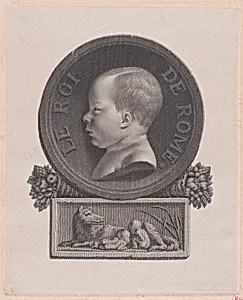
The King of Rome
Medium
Etching and stipple engraving on chine collé
Dimensions
Image: 7 15/16 × 6 7/16 in. (20.1 × 16.3 cm) Plate: 8 1/16 × 6 1/2 in. (20.5 × 16.5 cm) Sheet: 8 15/16 × 7 5/16 in. (22.7 × 18.5 cm)
Classification
Prints
Department
Drawings and Prints
Museum
Metropolitan Museum of Art, New York, NY
Credit
Bequest of James David Draper, 2019
Accession Number
2021.15.20
Rights
Public Domain
Art Historical Context
Created around 1811, “The King of” commemorates the birth of Napoleon’s only legitimate son, who was given the title King of Rome at his christening. The print captures the optimism of the Napoleonic court at its height, when the arrival of an heir seemed to promise dynastic stability for the new empire. Pierre-Paul Prud’hon, a favorite artist of both Napoleon and Josephine, supplied the tender, softly modeled design; engraver Roger Barthélemy translated it into etching and stipple, techniques prized for their delicate tonal gradations and ability to suggest the velvety textures of infancy. The choice of medium is itself significant. Chine collé allowed the fine stipple work to be printed on a thin sheet of high-quality paper that was then bonded to a sturdier support, producing luminous highlights and subtle shadows suited to an intimate royal portrait. Widely distributed as prints, such images helped shape public perception of the imperial family, turning a private milestone into a shared symbol of continuity and hope. Today the impression in the Metropolitan Museum’s collection preserves both the elegance of Prud’hon’s vision and the technical refinement of early-nineteenth-century printmaking, offering viewers a glimpse of how art and politics intertwined during the First Empire.
About the Artist
Roger Barthélemy|Pierre Paul Prud'hon (French|French) · 1770 |1758 –1841 |1823
French, 1770–1841|French, Cluny 1758–1823 Paris