
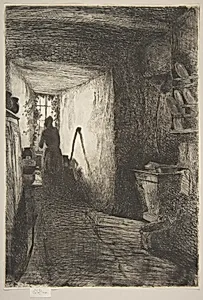
The Kitchen
[1858] republished 1885
Medium
Etching, printed in black ink on fine ivory laid paper; third state of three (Glasgow)
Dimensions
Plate: 8 15/16 × 6 3/16 in. (22.7 × 15.7 cm) Sheet: 9 x 6 1/4 in. (22.9 x 15.9 cm)
Classification
Prints
Department
Drawings and Prints
Museum
Metropolitan Museum of Art, New York, NY
Credit
Harris Brisbane Dick Fund, 1917
Accession Number
17.3.20
Rights
Public Domain
Tags
Art Historical Context
James McNeill Whistler’s *The Kitchen* captures a quiet domestic interior from 1858, later republished in 1885 by The Fine Art Society in London. Created as an etching printed in black ink on fine ivory laid paper, this third state of three reveals the artist’s meticulous revisions to line and tone. At roughly nine by six inches, the intimate scale invites close looking at everyday details rendered with remarkable precision. Whistler, though best known today for his paintings and the Aesthetic Movement, was already an accomplished printmaker by his mid-twenties. This work belongs to his early French etchings, produced while he lived in Paris and explored scenes of ordinary life. The subject—a modest kitchen occupied by women—reflects the nineteenth-century interest in truthful depictions of labor and home, yet Whistler treats the space with elegant economy rather than sentimentality. The medium itself underscores the print’s historical value. Etching allowed Whistler to combine delicate line work with subtle tonal effects, achieving a luminous quality on the laid paper. Acquired by the Metropolitan Museum through the Harris Brisbane Dick Fund in 1917, the impression preserves the artist’s early mastery of the medium and offers visitors a glimpse into the quiet rhythms of mid-nineteenth-century domestic life.
About the Artist
James McNeill Whistler|The Fine Art Society, London · 1834–1903
James Abbott McNeill Whistler (1834-1903) was an American-born painter and printmaker who became a leading figure in the Aesthetic Movement and pioneer of Tonalism and Japonisme. He revolutionized art by championing "art for art's sake" and treating paintings as visual equivalents of musical compositions, titling works as "arrangements," "harmonies," and "nocturnes" to emphasize formal qualities o...