
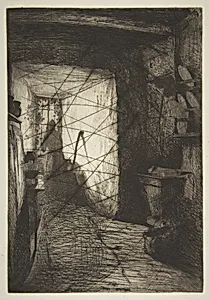
The Kitchen
[1858] republished 1885
Medium
Etching with drypoint cancellation lines; from the cancelled plate (Glasgow); black ink on pale green laid paper with unread letters watermark
Dimensions
plate: 8 7/8 x 6 1/8 in. (22.5 x 15.6 cm) sheet: 12 7/16 x 7 7/8 in. (31.6 x 20 cm)
Classification
Prints
Department
Drawings and Prints
Museum
Metropolitan Museum of Art, New York, NY
Credit
Gift of Theodore De Witt, 1923
Accession Number
23.65.79
Rights
Public Domain
Tags
Art Historical Context
James McNeill Whistler’s “The Kitchen,” originally etched in 1858 and reissued in 1885 from a cancelled plate, captures an intimate domestic interior with remarkable sensitivity. Created early in Whistler’s career during his time in France, the print reflects the artist’s interest in everyday scenes drawn from life. The use of etching combined with drypoint allows for delicate lines and subtle tonal effects that bring warmth and texture to the humble kitchen setting. Printed in black ink on pale green laid paper, this impression from the cancelled plate carries visible cancellation lines across the image. Such prints were sometimes produced to satisfy collector demand while protecting the integrity of the original composition. The modest scale—roughly 9 by 6 inches—emphasizes the quiet, personal nature of the subject. As part of the Metropolitan Museum’s holdings in Drawings and Prints, the work highlights Whistler’s mastery of the etching medium and his role in the nineteenth-century etching revival. It offers visitors a glimpse into the artist’s early exploration of light, space, and ordinary life.
About the Artist
James McNeill Whistler · 1834–1903
James Abbott McNeill Whistler (1834-1903) was an American-born painter and printmaker who became a leading figure in the Aesthetic Movement and pioneer of Tonalism and Japonisme. He revolutionized art by championing "art for art's sake" and treating paintings as visual equivalents of musical compositions, titling works as "arrangements," "harmonies," and "nocturnes" to emphasize formal qualities o...