
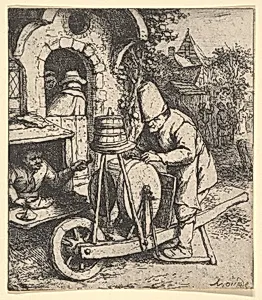
The Knifegrinder
1610–85
Medium
Etching
Dimensions
Sheet: 3 1/4 × 2 13/16 in. (8.3 × 7.2 cm)
Classification
Prints
Department
Drawings and Prints
Museum
Metropolitan Museum of Art, New York, NY
Credit
The Elisha Whittelsey Collection, The Elisha Whittelsey Fund, 1964
Accession Number
64.642.2
Rights
Public Domain
Tags
Art Historical Context
Adriaen van Ostade's *The Knifegrinder* (c. 1610–85) captures a slice of everyday life in the Dutch Golden Age through the intimate medium of etching. This small print, measuring just 3¼ × 2⅞ inches, depicts a working man sharpening knives—likely a street tradesman—amidst modest buildings, highlighting the humble labors that defined 17th-century Dutch society. Van Ostade, a master of genre scenes, often portrayed peasants and artisans with a keen eye for detail and subtle humor, elevating ordinary moments to artistic subjects. Etching, van Ostade's chosen technique here, involved coating a copper plate with acid-resistant ground, scratching lines into it, and immersing it in acid to etch the grooves. This allowed for rich, expressive lines that conveyed texture—from the grindstone's roughness to the worker's weathered features—making prints like this affordable and widely collectible. Produced during a booming era of printmaking in the Netherlands, it reflects the era's fascination with realism and social observation. Housed in the Metropolitan Museum of Art's Drawings and Prints department, *The Knifegrinder* exemplifies van Ostade's contribution to Baroque genre art, offering visitors a window into the vibrant, working-class world that fueled Dutch prosperity. Its compact scale invites close inspection, revealing the artist's empathy for the unsung heroes of daily toil.
About the Artist
Adriaen van Ostade · 1610–1685
Adriaen Jansz. van Ostade (1610-1685) was a Dutch Baroque painter and printmaker who specialized in genre scenes of peasant life. Born and raised in Haarlem, he became one of the most prolific and celebrated artists of the Dutch Golden Age, producing over 800 paintings, 50 etchings, and numerous drawings. Van Ostade's significance in art history lies in his masterful depiction of peasant life, a ...