
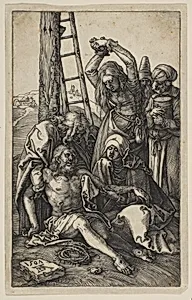
The Lamentation, from "The Passion"
1507
Medium
Engraving
Dimensions
Sheet: 4 13/16 × 3 1/16 in. (12.2 × 7.7 cm)
Classification
Prints
Department
Drawings and Prints
Museum
Metropolitan Museum of Art, New York, NY
Credit
Bequest of Alexandrine Sinsheimer, 1958
Accession Number
59.534.51
Rights
Public Domain
Tags
Art Historical Context
Albrecht Dürer's *The Lamentation*, created in 1507 as part of his renowned *Passion* series, captures a pivotal moment from the life of Christ: the sorrowful mourning of his body after the Crucifixion. This intimate engraving, measuring just 4 13/16 × 3 1/16 inches, draws from Northern Renaissance traditions, blending Dürer's meticulous German precision with Italian influences from his travels. As a master printmaker, Dürer engraving to high art, using fine lines and cross-hatching to convey profound emotion in a format that could be widely reproduced and shared. In this poignant scene, Christ's lifeless form is tenderly lowered from the cross with ladders—a symbolic detail evoking both human vulnerability and divine sacrifice—surrounded by grieving figures including the Virgin Mary, disciples, and holy women. Dürer's technique shines in the intricate textures: the taut ropes, folded drapery, and expressive faces rendered with extraordinary detail, inviting viewers to contemplate themes of loss and redemption central to early 16th-century Christian devotion. Housed in the Metropolitan Museum of Art's Drawings and Prints department, this work exemplifies how Dürer's innovations democratized religious imagery, making profound spiritual narratives accessible beyond elite patrons. A testament to his enduring legacy, it reminds us of art's power to console and inspire across centuries.
About the Artist
Albrecht Dürer · 1471–1528
Albrecht Dürer (1471–1528) stands as the preeminent figure of the Northern Renaissance and arguably the most influential artist in the history of printmaking. Born in Nuremberg on May 21, 1471, and dying in the same city on April 6, 1528, Dürer revolutionized the status of the artist in Northern Europe, transforming printmaking from a commercial craft into an independent fine art and establishing ...