
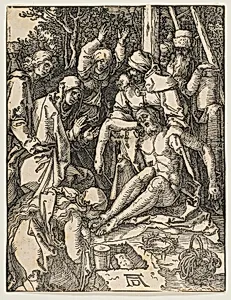
The Lamentation, from "The Small Passion"
ca. 1509
Medium
Woodcut
Dimensions
sheet: 5 1/8 x 3 7/8 in. (13 x 9.9 cm)
Classification
Prints
Department
Drawings and Prints
Museum
Metropolitan Museum of Art, New York, NY
Credit
The George Khuner Collection, Gift of Mrs. George Khuner, 1975
Accession Number
1975.653.49
Rights
Public Domain
Tags
Art Historical Context
Albrecht Dürer’s *The Lamentation* belongs to his celebrated “Small Passion” series, a sequence of woodcuts created around 1509–1511 that traces the final days of Christ’s life. As one of the most influential artists of the Northern Renaissance, Dürer used these intimate prints to bring sacred stories into everyday homes. The compact format—roughly five by four inches—made the series affordable and portable, allowing viewers to meditate on the Passion in private devotion. In this scene, the Virgin Mary cradles her son’s body while mourners gather in quiet sorrow. Dürer’s masterful woodcut technique transforms the humble medium into a vehicle for expressive power: fine, incised lines convey the weight of fabric, the softness of hair, and the tension of grief with remarkable clarity. The stark contrasts of black and white heighten the emotional drama, guiding the eye from Christ’s lifeless form to the anguished faces around him. Beyond its devotional purpose, the print reflects Dürer’s innovative approach to printmaking, which helped elevate woodcuts from simple illustrations to sophisticated works of art. Today it remains a moving example of how Renaissance artists used new reproductive technologies to share profound religious narratives with a wide audience.
About the Artist
Albrecht Dürer · 1471–1528
Albrecht Dürer (1471–1528) stands as the preeminent figure of the Northern Renaissance and arguably the most influential artist in the history of printmaking. Born in Nuremberg on May 21, 1471, and dying in the same city on April 6, 1528, Dürer revolutionized the status of the artist in Northern Europe, transforming printmaking from a commercial craft into an independent fine art and establishing ...