
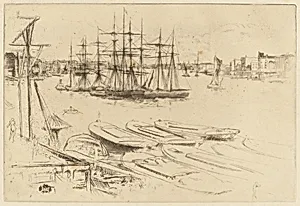
The Large Pool
c. 1879
Medium
etching and drypoint on Asian laid paper
Dimensions
plate: 18.8 × 27.8 cm (7 3/8 × 10 15/16 in.) sheet: 28.8 × 38.7 cm (11 5/16 × 15 1/4 in.)
Classification
Department
CG-W
Museum
National Gallery of Art, Washington, D.C.
Credit
Rosenwald Collection
Accession Number
1943.3.8507
Rights
Public Domain
Art Historical Context
James McNeill Whistler's *The Large Pool* (c. 1879) invites visitors into the artist's masterful world of subtle tonalities and atmospheric depth. Created as an etching and drypoint on Asian laid paper, this print measures a modest plate size of 18.8 × 27.8 cm, yet it captures expansive tranquility—likely evoking Venice's shimmering waterways during Whistler's sojourn there. Housed in the National Gallery of Art's Rosenwald Collection, it exemplifies his classification as a fine print, blending precision with poetic suggestion. Whistler, a leading figure in the Aesthetic movement and champion of "art for art's sake," revolutionized printmaking in the late 19th century. Amid financial struggles, his 1879-1880 Venice trip inspired the Second Venice Set, including this work, where he elevated etching from reproductive medium to independent art. Drypoint's soft, burr-rich lines add velvety texture over etched precision, while the Asian paper—prized for its absorbency and subtle grain—enhances ink's delicate gradations, mimicking his famed oil nocturnes. This piece highlights Whistler's harmony of line and tone, influencing modern printmakers. Its cultural resonance lies in bridging East and West, as Whistler drew from Japanese aesthetics to prioritize mood over narrative, offering timeless serenity for today's viewers.
About the Artist
James McNeill Whistler · 1834–1903
James Abbott McNeill Whistler (1834-1903) was an American-born painter and printmaker who became a leading figure in the Aesthetic Movement and pioneer of Tonalism and Japonisme. He revolutionized art by championing "art for art's sake" and treating paintings as visual equivalents of musical compositions, titling works as "arrangements," "harmonies," and "nocturnes" to emphasize formal qualities o...