
The Last Jig or Adieu to Old England
January 10, 1818
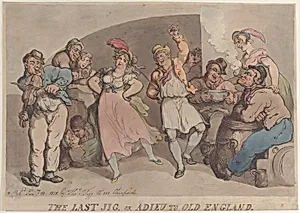
Medium
Hand-colored etching; proof before letters
Dimensions
Sheet: 9 1/4 × 13 1/4 in. (23.5 × 33.6 cm)
Classification
Prints
Department
Drawings and Prints
Museum
Metropolitan Museum of Art, New York, NY
Credit
The Elisha Whittelsey Collection, The Elisha Whittelsey Fund, 1959
Accession Number
59.533.1780
Rights
Public Domain
Tags
Art Historical Context
Step into the lively world of-era satire with *The Last Jig or Adieu to Old*, a hand-colored etching created by master caricaturist Thomas Rowland and published by Thomas Tegg on 10, 1818. This proof before letters—a rare early impression without added text—measures 9¼ × 13¼ inches and captures Rowlandson's signature wit through exaggerated figures and vibrant hand-coloring. Housed in the Metropolitan Museum of Art's Drawings and Prints department, it exemplifies the booming British print culture of the time. The scene bursts with men and women dancing a final "jig," accompanied by musicians, evoking a bittersweet farewell to traditional English life. Created amid post-Napoleonic economic woes and rising emigration to America and Australia, the title likely pokes fun at those bidding adieu to "Old England" amid social upheaval. Rowlandson, a leading figure in 18th- and 19th-century caricature, used etching's fine lines and bold colors to lampoon everyday follies, blending humor with sharp commentary on class and change. This print's cultural punch lies in its snapshot of Regency revelry—rowdy, relatable, and reflective of a shifting Britain. As a hand-colored piece, it highlights the artisanal craft that made such satires affordable collectibles for the middle class, preserving a playful yet poignant moment in history.
About the Artist
Thomas Rowlandson|Thomas Tegg · 1756–1827
Thomas Rowlandson (1757–1827) was an English artist and caricaturist whose satirical watercolors and prints captured the social life of Georgian Britain with unparalleled wit and technical mastery. Alongside James Gillray, he is recognized as one of the greatest British graphic artists, and his distinctive flowing line and keen observations have made his work integral to understanding late 18th an...