
The Last Supper
1578–1615
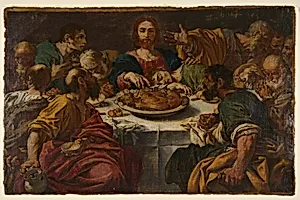
Medium
Brush and red, blue, yellow-brown, brown, green, and mauve oil paint on paper, pasted onto canvas
Dimensions
9 5/16 x 14 1/2in. (23.7 x 36.8cm)
Classification
Drawings
Department
Drawings and Prints
Museum
Metropolitan Museum of Art, New York, NY
Credit
Rogers Fund, 1961
Accession Number
61.27
Rights
Public Domain
Tags
Art Historical Context
Bartolomeo Schedoni *The Last Supper* (ca. 1578–1615) offers an intimate glimpse into one of Christianity's most iconic scenes: Jesus sharing his final meal with the apostles before his crucifixion. This small-scale work, measuring just 9 5/16 x 14 1/2 inches, captures the solemnity and emotional weight of the biblical moment, a theme immortalized by masters like Leonardo da Vinci but reinterpreted here by the Emilian artist in a more personal, preparatory style. Schedoni, active in late 16th- and early 17th-century Italy, drew from the region's rich tradition of religious art, blending Mannerist elegance with emerging Baroque drama. Rendered in brush and a vivid palette of red, blue, yellow-brown, brown, green, and mauve oil paints on paper—later pasted onto canvas—this piece exemplifies the *bozzetto*, or oil sketch, favored by Italian artists for planning larger compositions. The fluid application and layered colors highlight Schedoni's technical skill, allowing for luminous effects and subtle modeling on an unconventional support typically reserved for drawings. Acquired through the Rogers Fund in 1961 and housed in the Metropolitan Museum of Art's Drawings and Prints department, this work underscores the cultural reverence for the Eucharist in Counter-Reformation Europe. Its tags—Food, Jesus, Last Supper—evoke the sacramental symbolism of bread and wine, inviting visitors to ponder faith, betrayal, and fellowship in a remarkably approachable format.