
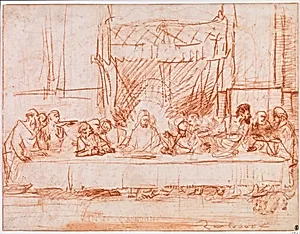
The Last Supper, after Leonardo da Vinci
Rembrandt (Rembrandt van Rijn), 1634–35
About this artwork
In the Robert Lehman Collection at The Metropolitan Museum of Art, van Rijn's *The Last Supper, after da Vinci* (1634–35) captivates with its intimate red chalk drawing. Measuring 14¼ × 18⅝ inches, this work is a thoughtful homage to Leonardo's iconic mural in Milan, rendered during Rembrandt's early Amsterdam years when he was honing his craft as a master draftsman. At just 28–29 years old, Rembrandt produced this study to absorb the Italian Renaissance master's revolutionary composition, where Christ shares his final meal with the Apostles in a moment of profound tension and humanity. Rembrandt's Baroque sensibility infuses the scene with dramatic depth, using red chalk's warm, velvety tones to model figures with subtle chiaroscuro—light and shadow interplaying to evoke emotion and volume. Unlike Leonardo's fresco, this drawing emphasizes tactile intimacy, showcasing Rembrandt's virtuoso technique in capturing expressions of betrayal and sorrow around the table. Such copies were common among Northern artists traveling or studying Italian works, bridging Renaissance innovation with Dutch realism. Displayed among the Met's treasures since 1975, this piece highlights Rembrandt's lifelong admiration for Leonardo and his genius for drawings that feel alive, inviting visitors to ponder the timeless drama of the Last Supper through a young artist's reverent gaze.