
The Laundress
Honoré Daumier, 186[3?]
About this artwork
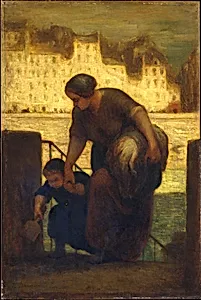
In the heart of 19th-century Paris, Honoré Daumier captured the quiet dignity of everyday laborers in *The Laundress* (ca. 1863), a poignant oil painting on oak panel measuring just 19¼ × 13 inches. Daumier, a master of French Realism, was renowned for his empathetic portrayals of the working class amid the social upheavals of the Industrial Revolution. This intimate-scale work, now in the Metropolitan Museum of Art thanks to the bequest of Lillie P. Bliss in 1931, highlights the tag-worthy themes of women and children, evoking the tireless routines of urban laundresses who toiled along the Seine. Daumier's loose, expressive brushwork and dramatic chiaroscuro infuse the scene with emotional depth, transforming a mundane moment into a powerful commentary on labor and resilience. Oil on oak—a durable, portable medium favored for small studies—allowed him to achieve rich textures and subtle tonal shifts, emphasizing the physical strain and tenderness between mother and child. As a caricaturist turned painter, Daumier elevated ordinary lives, influencing later Realists like Degas and influencing our view of 19th-century social history. Visitors will appreciate how this gem humanizes the overlooked, reminding us of the enduring strength in simple acts of care.