
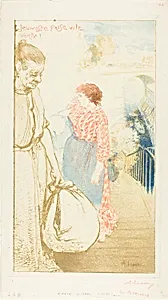
The Laundresses
Medium
Soft ground etching with aquatint and roulette from three plates on cream wove paper
Dimensions
Image: 38.3 × 21.5 cm (15 1/8 × 8 1/2 in.); Plate: 39.4 × 22.8 cm (15 9/16 × 9 in.); Sheet: 45 × 25.4 cm (17 3/4 × 10 in.)
Classification
etching
Department
Prints and Drawings
Museum
Art Institute of Chicago
Accession Number
11582
Rights
Public Domain
Art Historical Context
In the late 19th century, artist Louis Auguste Lepère the everyday rhythms of urban life in *The Laundresses* (1894), a etching housed in the Art Institute of's Prints and Drawings collection. This intimate scene likely depicts women at work by the water's edge, reflecting the artist's fascination with ordinary laborers and the bustling streets of Paris. Created during a period when printmaking flourished as an accessible art form, Lepère's work the era's growing appreciation for Realism in graphic arts, bridging fine art and illustration. Lepère employed sophisticated techniques—soft ground etching, aquatint, and roulette—printed from three plates on cream wove paper to achieve rich tonal depth and subtle textures. Soft ground etching allows for soft, velvety lines mimicking pencil strokes, while aquatint and roulette add granular shading and patterned effects, evoking the play of light on damp fabrics and rippling water. Measuring 38.3 × 21.5 cm, the image's compact scale invites close viewing, highlighting the precision of multi-plate printing, a labor-intensive process that elevated etching beyond mere reproduction. As a master printmaker, Lepère's innovative approach contributed to the revival of original prints in fin-de-siècle Europe, making scenes of working women culturally resonant symbols of modernity and resilience. Visitors to the Art Institute can appreciate how this piece democratizes art, turning the mundane into the monumental.
About the Artist
Louis Auguste Lepère · 1849–1918
Louis-Auguste Lepère (1849–1918) was born in Paris on November 30 to the sculptor François Lepère, immersing him early in the artistic world. At age thirteen, he apprenticed in the studio of the English wood engraver Joseph Burn-Smeeton, training there from 1862 to 1867, and later attended drawing courses under Horace Lecoq de Boisbaudran at the Petite École (now École nationale supérieure des art...