
神功皇后図|The Legendary Empress Jingū
dated 1847
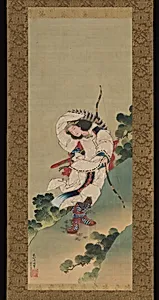
Medium
Hanging scroll; ink and color on silk
Dimensions
Image: 31 3/4 × 12 1/2 in. (80.7 × 31.7 cm) Overall with mounting: 64 7/16 × 17 9/16 in. (163.7 × 44.6 cm) Overall with knobs: 64 7/16 × 19 5/16 in. (163.7 × 49 cm)
Classification
Paintings
Culture & Period
Japan · Edo period (1615–1868)
Department
Asian Art
Museum
Metropolitan Museum of Art, New York, NY
Credit
Charles Stewart Smith Collection, Gift of Mrs. Charles Stewart Smith, Charles Stewart Smith Jr., and Howard Caswell Smith, in memory of Charles Stewart Smith, 1914
Accession Number
14.76.36
Rights
Public Domain
Tags
About this artwork
神功皇后図|The Legendary Empress Jingū by Katsushika Hokusai 葛飾北斎, dated 1847. Created in Hanging scroll; ink and color on silk, this work exemplifies the artistic practices and cultural values of its period. The piece reflects the technical skills and aesthetic sensibilities characteristic of its historical and cultural context. As part of the Asian Art collection, it contributes to our understanding of artistic development and cultural expression. The work serves as both an aesthetic object and a h...
Art Historical Context
Katsushika Hokusai, the renowned Japanese artist famed for his ukiyo-e woodblock prints like *The Great Wave off Kanagawa*, created *The Legendary Empress Jingū* in 1847, late in his prolific career. This hanging scroll, rendered in ink and color on silk, measures about 32 by 12 inches in its image area and exemplifies Hokusai's mastery of traditional Japanese painting formats. Produced during the Edo period (1615–1868), it reflects the era's vibrant fusion of myth, history, and artistry, when hanging scrolls were cherished for seasonal display in homes or temples. The subject, Empress Jingū (Jingū Kōgō), is a legendary 3rd-century figure from Japan's ancient chronicles like the *Kojiki*. Revered as a shamaness and warrior queen, she is often depicted leading military campaigns against Korea—supernaturally pausing her pregnancy through divine prayer. Here, tags suggest her portrayal with bow and arrow, emphasizing female empowerment and martial prowess in a culture that mythologized strong women rulers. Hokusai's dynamic composition likely captures her poised intensity, blending historical reverence with dramatic flair. As part of the Metropolitan Museum of Art's Asian Art collection, this work highlights Hokusai's versatility beyond prints, showcasing delicate silk layering, fluid ink lines, and vivid colors that convey both spiritual aura and narrative vitality. It offers visitors a window into Edo Japan's cultural devotion to heroic legends, inviting reflection on timeless themes of power and divinity.
About the Artist
Katsushika Hokusai 葛飾北斎 (Japanese) · 1760 –1849
Japanese, Tokyo (Edo) 1760–1849 Tokyo (Edo)