
The Little Mast
1879/80
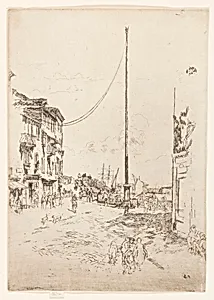
Medium
Etching and drypoint with foul biting in black ink on ivory laid paper
Dimensions
Image, trimmed within platemark: 26.5 × 18.7 cm (10 7/16 × 7 3/8 in.); Sheet: 27 × 18.7 cm (10 11/16 × 7 3/8 in.)
Classification
etching
Department
Prints and Drawings
Museum
Art Institute of Chicago
Accession Number
80134
Rights
Public Domain
Art Historical Context
James McNeill Whistler, leading figure in the Aesthetic movement, created *The Little Mast* around 1879–80 his transformative trip to Venice. Exiled from London after his infamous libel trial against critic John Ruskin, Wh sought inspiration in the city's shimmering canals and misty atmospheres. This etching captures the essence of Venetian life—likely a quiet harbor scene with a solitary mast—reflecting his shift toward subtle, evocative prints that prioritized mood over narrative detail. Whistler's mastery shines in his innovative use of etching and drypoint on ivory laid paper. Etching creates precise lines through acid-bitten plates, while drypoint adds velvety burrs from direct needle scratches, building rich textures. The "foul biting"—unintended acid corrosion—lends an organic, atmospheric grit, enhancing the work's tonal subtlety. At just 26.5 × 18.7 cm, this intimate print exemplifies Whistler's "art for art's sake" philosophy, influencing modern printmaking. Housed in the Art Institute of Chicago's Prints and Drawings collection, *The Little Mast* is part of Whistler's acclaimed Venice series, blending Realism's precision with Impressionistic light effects. It's a testament to how personal adversity fueled artistic brilliance, inviting viewers to savor Venice's elusive beauty through Whistler's discerning eye.
About the Artist
James McNeill Whistler · 1834–1903
James Abbott McNeill Whistler (1834-1903) was an American-born painter and printmaker who became a leading figure in the Aesthetic Movement and pioneer of Tonalism and Japonisme. He revolutionized art by championing "art for art's sake" and treating paintings as visual equivalents of musical compositions, titling works as "arrangements," "harmonies," and "nocturnes" to emphasize formal qualities o...