
The Long Balcony
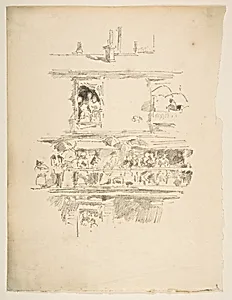
Medium
Transfer lithograph, printed in black ink on medium weight laid paper; second state of two (Chicago)
Dimensions
10 3/4 x 8 1/4 in. (27.3 x 21 cm)
Classification
Prints
Department
Drawings and Prints
Museum
Metropolitan Museum of Art, New York, NY
Credit
Harris Brisbane Dick Fund, 1917
Accession Number
17.3.197
Rights
Public Domain
Tags
Art Historical Context
James McNeill Whistler, celebrated American-born artist known for his Aesthetic movement ideals of "art for art's sake," *The Long Balcony* 1894. This intimate transfer lithograph captures the graceful architecture of a balcony, evoking Whistler's fascination with subtle harmonies, tonal subtlety, and everyday urban elegance. Printed in black ink on medium-weight paper, it measures just 10¾ × 8¼ inches, inviting close contemplation of its delicate lines and atmospheric depth. Whistler's mastery of lithography shines here: the transfer method allowed him to draw fluidly on paper before transferring to stone, achieving painterly effects akin to his famous nocturnes and etchings. This second state of two (Chicago variant) reflects his experimental printmaking during the late 19th century, a period when he produced series exploring light, shadow, and form—influenced by Japanese prints and his Venice sojourns. Acquired through the Harris Brisbane Dick Fund in 1917, it resides in the Metropolitan Museum of Art's Prints collection. For visitors, *The Long Balcony* offers a window into Whistler's refined vision, where a simple balcony becomes a symphony of line and space, bridging fine art and the ephemeral beauty of the everyday.
About the Artist
James McNeill Whistler · 1834–1903
James Abbott McNeill Whistler (1834-1903) was an American-born painter and printmaker who became a leading figure in the Aesthetic Movement and pioneer of Tonalism and Japonisme. He revolutionized art by championing "art for art's sake" and treating paintings as visual equivalents of musical compositions, titling works as "arrangements," "harmonies," and "nocturnes" to emphasize formal qualities o...