
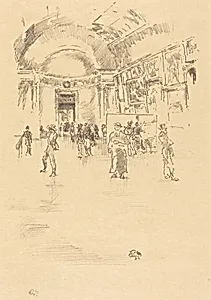
The Long Gallery, Louvre
Medium
lithograph in black on laid paper
Dimensions
image: 21.6 × 15.9 cm (8 1/2 × 6 1/4 in.) sheet: 33.5 × 23.8 cm (13 3/16 × 9 3/8 in.)
Classification
Department
CG-W
Museum
National Gallery of Art, Washington, D.C.
Credit
Rosenwald Collection
Accession Number
1943.3.8712
Rights
Public Domain
Art Historical Context
Step into the grand halls of Paris's Louvre Museum through James McNeill Whistler'sThe Long Gallery, Louvre (1894), a lithograph that captures the architectural splendor of one of the world's most iconic institutions. Whistler, the American-born artist renowned for his Aesthetic movement affiliations and subtle tonal harmonies—like his famous *Arrangement in Grey and Black No.1* (Whistler's Mother)—here turns his masterful eye to interior architecture. Printed in black ink on laid paper, this measures a modest image size of 21.6 × 15.9 cm, allowing intimate appreciation of its delicate lines and atmospheric depth. Lithography, Whistler's chosen medium, exemplifies 19th-century printmaking innovation: the artist draws directly on a lithographic stone with greasy crayon, exploiting the stone's affinity for oil-based inks to produce rich, velvety blacks and nuanced grays. This technique enabled Whistler to evoke the Long Gallery's vastness and light play with remarkable subtlety, aligning with his philosophy of "art for art's sake," prioritizing mood over narrative. Created late in his career, it reflects his enduring fascination with European grandeur amid the fin-de-siècle cultural shifts. Housed in the National Gallery of Art's Rosenwald Collection, this print invites visitors to ponder the Louvre's role as a cultural beacon, bridging Whistler's transatlantic vision with France's artistic legacy. A testament to print's democratic power, it makes high art accessible, much like the museum itself.
About the Artist
James McNeill Whistler · 1834–1903
James Abbott McNeill Whistler (1834-1903) was an American-born painter and printmaker who became a leading figure in the Aesthetic Movement and pioneer of Tonalism and Japonisme. He revolutionized art by championing "art for art's sake" and treating paintings as visual equivalents of musical compositions, titling works as "arrangements," "harmonies," and "nocturnes" to emphasize formal qualities o...