
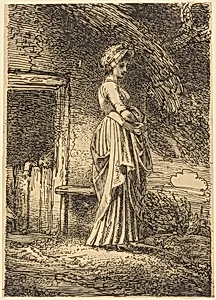
The Lost Apple
1803
Medium
pen-and-tusche lithograph
Classification
Department
CG-E
Museum
National Gallery of Art, Washington, D.C.
Credit
Rosenwald Collection
Accession Number
1947.7.136
Rights
Public Domain
Art Historical Context
Thomas Stothard’s “The Lost Apple,” created in 1803, represents an early and technically refined example of lithography, a printmaking process invented only a few years earlier in Germany. Using pen-and-tusche techniques, Stothard drew directly on the stone with both fine lines and liquid tusche washes, achieving delicate tonal gradations and fluid contours that were difficult to obtain in contemporary engraving or etching. This medium’s ability to reproduce an artist’s spontaneous hand made it especially appealing for book illustration and independent prints during the Romantic era. Stothard, a leading British illustrator and painter of the late eighteenth and early nineteenth centuries, worked across neoclassical and emerging romantic sensibilities. His prolific output often graced literary editions and exhibition prints, bridging fine art and popular visual culture. Acquired for the National Gallery of Art’s Rosenwald Collection, this impression preserves the freshness of one of lithography’s earliest artistic applications in Britain, offering viewers a glimpse of how the new process expanded expressive possibilities for artists at the dawn of the nineteenth century.
About the Artist
Thomas Stothard · 1755–1834
Thomas Stothard RA (1755–1834) was born on 17 August 1755 at the Black Horse Inn in London's Long Acre, the son of a prosperous publican originally from Stutton near Tadcaster. A delicate child, he was sent at age five to relatives in Yorkshire, attending schools in Acomb, Tadcaster, and later Ilford, Essex, where he honed his drawing skills by copying prints. Following his father's death in 1770,...