
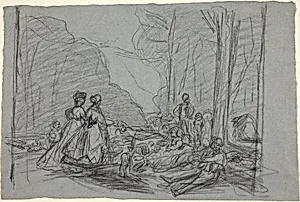
The Luncheon on the Grass
c. 1865
Medium
black chalk on blue laid paper
Dimensions
overall: 30.5 x 46.8 cm (12 x 18 7/16 in.)
Classification
Drawing
Department
CG-E
Museum
National Gallery of Art, Washington, D.C.
Credit
Collection of Mr. and Mrs. Paul Mellon
Accession Number
1995.47.60
Rights
Public Domain
Art Historical Context
Claude Monet's *The Luncheon on the Grass*, created around 1865, is a captivating black chalk drawing on blue laid paper, measuring 30.5 x 46.8 cm. Housed in the National Gallery of Art's Collection of Mr. and Mrs. Paul Mellon, this work captures the artist's early experimentation during a pivotal moment in French art. At just 25 years old, Monet was transitioning from academic training toward the innovative plein-air techniques that would define Impressionism, though this intimate drawing hints at his emerging focus on everyday scenes bathed in natural light. The use of black chalk on blue paper exemplifies 19th-century preparatory techniques, allowing for rich contrasts and subtle tonal modeling. Laid paper, with its textured surface, provided an ideal ground for chalk's soft, blendable marks, enabling Monet to sketch figures in a leisurely outdoor setting—likely a picnic amid foliage. This drawing may relate to Monet's ambitious *Le Déjeuner sur l'herbe* painting series from the same period, which explored modern leisure and optical effects, challenging the rigid Salon traditions. As a rare surviving study, it offers a window into Monet's process, bridging his realist roots with Impressionist spontaneity. Visitors will appreciate its delicate execution and the way it evokes a sun-dappled afternoon, inviting reflection on how such sketches fueled one of art history's most revolutionary movements.
About the Artist
Claude Monet · 1840–1926
Claude Monet, born Oscar-Claude Monet on November 14, 1840, in Paris and raised in Le Havre, Normandy, began his artistic journey as a successful teenage caricaturist. His formal training started at the Le Havre secondary school of the arts in 1851, where he received his first drawing lessons from Jacques-François Ochard. Around 1858, he met Eugène Boudin, who became his pivotal mentor, introducin...