
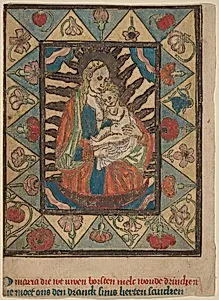
The Madonna and Child
c. 1500
Medium
woodcut, hand-colored in light and dark blue, red, green, yellow, orange, lavender and gold
Dimensions
sheet: 14.4 × 10.5 cm (5 11/16 × 4 1/8 in.)
Classification
Department
CG-E
Museum
National Gallery of Art, Washington, D.C.
Credit
Rosenwald Collection
Accession Number
1946.21.191
Rights
Public Domain
Art Historical Context
Behold *The Madonna and Child*, a delicate woodcut from the late 15th century, by an anonymous Netherland artist around 1500. This intimate print, measuring just 14.4 × 10.5 cm, captures the tender devotion central to Christian iconography during the Northern Renaissance. Housed in the National Gallery of Art'swald Collection, it exemplifies early printmaking's role in making sacred imagery accessible to everyday believers. Crafted as a woodcut—where intricate designs were carved into a wooden block and inked for transfer to paper—the artwork was then lovingly hand-colored with light and dark blue, red, green, yellow, orange, lavender, and gold. This labor-intensive enhancement transformed a humble print into a vibrant, jewel-like object, bridging the gap between mass production and personal artistry. In the Netherlands of the 1400s, such techniques flourished amid a printing revolution, allowing devotional images to spread widely beyond elite workshops. Its small scale suggests it was cherished as a private prayer aid, reflecting the era's growing emphasis on individual piety. This piece highlights woodcuts' cultural impact: affordable yet spiritually profound, they democratized art and faith in a time of religious fervor and artistic innovation.