
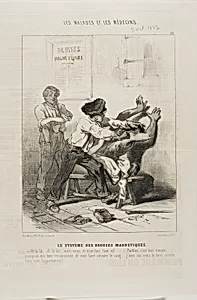
The Magnetic Brush Method (plate 21)
Medium
Lithograph in black on ivory wove paper
Dimensions
Image: 23.5 × 18.4 cm (9 5/16 × 7 1/4 in.); Sheet: 35.1 × 23.4 cm (13 7/8 × 9 1/4 in.)
Classification
lithograph
Department
Prints and Drawings
Museum
Art Institute of Chicago
Accession Number
51150
Rights
Public Domain
Art Historical Context
**The Magnetic Brush Method (plate21)**, a delicate 1843 lithograph by French artist Charles Émile Jac, offers a glimpse into the innovative world of 19th-centurymaking. Jacque (1813–1894), a key figure in the Barbizon School alongside artists like Millet and Rousseau, was renowned for his vivid depictions of rural life, farm animals, and pastoral scenes. Though best known for his etchings of chickens and peasants, this work showcases his mastery of lithography, a medium he helped popularize in France. Printed in black ink on creamy ivory wove paper (image: 23.5 × 18.4 cm; sheet: 35.1 × 23.4 cm), the piece highlights the "magnetic brush method"—likely a specialized technique using a brush to apply greasy tusche or crayon to the lithographic stone, allowing for fluid, expressive lines. Invented in the late 18th century, lithography exploded in the 1840s as an affordable way to reproduce detailed images, bridging fine art and mass dissemination. As plate 21, it suggests part of an instructional series, democratizing advanced print techniques for aspiring artists. Housed in the Art Institute of Chicago's Prints and Drawings Department, this modest yet technically brilliant work underscores lithography's role in artistic education and innovation, inviting us to appreciate the behind-the-scenes magic that brought Jacque's rustic visions to life.