
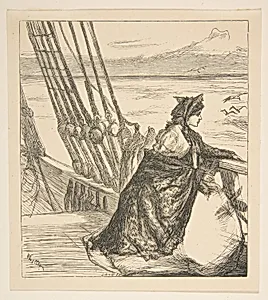
The Major's Daughter (from "Once a Week")
June 21, 1862
Medium
Wood engraving; proof
Dimensions
Sheet: 6 7/8 × 5 1/4 in. (17.5 × 13.3 cm)
Classification
Prints
Department
Drawings and Prints
Museum
Metropolitan Museum of Art, New York, NY
Credit
Harris Brisbane Dick Fund, 1917
Accession Number
17.3.257
Rights
Public Domain
Tags
Art Historical Context
Step into the Victorian world of illustrated periodicals with *The Major's Daughter*, delicate wood engraving created by James McNeill Wh in collaboration with engraver Joseph Swain, published the magazine *Once a Week on June 21, 1862. Whistler, the innovative American artist then thriving in London's art scene, was experimenting with graphic arts early in his career, blending emerging realist style with the narrative flair of 19th-century illustration. This proof print captures a poignant scene evoking women and ships—perhaps a tale of seafaring romance or familial longing—reflecting the era's fascination with maritime adventures and domestic sentiment. Printed on a modest sheet of 6 7/8 × 5 1/4 inches, the wood engraving technique showcases fine lines incised into hardwood blocks, allowing for intricate details and tonal subtlety that rivaled emerging photography. As a proof, this trial impression reveals the meticulous refinement process before mass reproduction, highlighting Whistler's precision before he pioneered Aestheticism in painting and etching. Swain's expert engraving amplified Whistler's fluid designs, making complex textures like rippling waves or flowing garments leap off the page. Housed in the Metropolitan Museum of Art's Drawings and Prints department (Harris Brisbane Dick Fund, 1917), this work offers a window into Whistler's versatile beginnings and the cultural vibrancy of Victorian serials, where art met literature to enchant middle-class readers.
About the Artist
James McNeill Whistler|Joseph Swain · 1834–1903
James Abbott McNeill Whistler (1834-1903) was an American-born painter and printmaker who became a leading figure in the Aesthetic Movement and pioneer of Tonalism and Japonisme. He revolutionized art by championing "art for art's sake" and treating paintings as visual equivalents of musical compositions, titling works as "arrangements," "harmonies," and "nocturnes" to emphasize formal qualities o...