
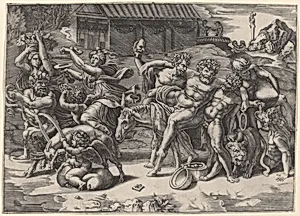
The March of Silenus
1401 to 1500
Medium
engraving
Classification
Department
CG-E
Museum
National Gallery of Art, Washington, D.C.
Credit
Ailsa Mellon Bruce Fund
Accession Number
1972.33.14
Rights
Public Domain
Art Historical Context
The March of Silenus, an engraving created by Agostino dei Musi between 1401 and 1500, captures a lively mythological procession centered on Silenus, the companion of the wine god Dionysus. As a print in the collection of the National Gallery of Art, acquired through the Ailsa Mellon Bruce Fund, this work reflects the growing importance of engraving during the Renaissance. The medium allowed artists to reproduce intricate designs on paper, making mythological subjects more widely accessible beyond the walls of palaces and churches. Agostino dei Musi’s technique demonstrates the precision and detail possible with engraving, where fine lines etched into metal plates could convey movement, texture, and expressive figures. Created in the fifteenth century, the print belongs to a period when classical myths were being revived and reinterpreted through a Renaissance lens, blending ancient stories with contemporary artistic innovation. Its classification as a print highlights how such works helped spread cultural ideas across Europe. Visitors can appreciate how this engraving preserves the energy of a festive mythological scene while showcasing the technical mastery that defined early printmaking. The artwork invites reflection on humanity’s enduring fascination with ancient legends and the role of prints in shaping visual culture.