
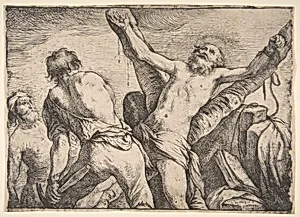
The Martyrdom of Saint Andrew
1623
Medium
Etching
Dimensions
sheet: 7 3/8 x 10 3/8 in. (18.8 x 26.4 cm)
Classification
Prints
Department
Drawings and Prints
Museum
Metropolitan Museum of Art, New York, NY
Credit
A. Hyatt Mayor Purchase Fund, Marjorie Phelps Starr Bequest, 2011
Accession Number
2011.28
Rights
Public Domain
Tags
Art Historical Context
Claude Vignon's *The Martyrdom of Andrew* (1623) is a striking etching that captures the dramatic suffering of the apostle saint, one of Jesus's earliest followers. Depicting Andrew's crucifixion on the iconic X-shaped cross—an instrument of torture chosen to distinguish his martyrdom from Christ's— the print evokes intense pathos through its focus on male figures enduring torment. Vignon's composition, rendered on a modest sheet measuring 7 3/8 x 10 3/8 inches, draws viewers into the saint's final moments, a theme resonant in 17th-century religious art amid the Catholic Counter-Reformation's emphasis on devotion and sacrifice. As an etching, this work exemplifies a pivotal printmaking technique where acid etches intricate lines into a metal plate, allowing for detailed, expressive reproductions that could reach wide audiences beyond original paintings. Vignon's mastery of the medium shines in conveying texture and emotion, making sacred narratives accessible to the faithful. Housed in the Metropolitan Museum of Art's Drawings and Prints department, acquired through the A. Hyatt Mayor Purchase Fund and Marjorie Phelps Starr Bequest in 2011, it highlights the enduring cultural importance of such prints in preserving Baroque-era spirituality and human endurance. This piece invites reflection on faith's trials, blending historical reverence with artistic innovation for modern museumgoers.
About the Artist
Claude Vignon · 1593–1670
Claude Vignon was born on May 19, 1593, in Tours, France, into a wealthy family, and he died on May 10, 1670, in Paris. He received his initial artistic training in Paris under the Mannerist painter Jacob Bunel, a key figure in the Second School of Fontainebleau. Vignon traveled extensively in his youth, likely visiting Rome as early as 1609–1610 and settling there by 1616–1619 among the French ar...