
The Martyrdom of St. Peter Martyr
1615–73
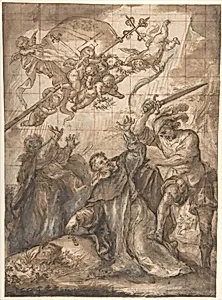
Medium
Pen and brown ink, brown wash over black chalk, highlighted with white on off-white paper. Squared in red chalk and traces of construction lines in black chalk, close to borders
Dimensions
17-7/8 x 13-3/16 in. (45.4 x 33.5 cm)
Classification
Drawings
Department
Drawings and Prints
Museum
Metropolitan Museum of Art, New York, NY
Credit
Bequest of Harry G. Sperling, 1971
Accession Number
1975.131.203
Rights
Public Domain
Tags
Art Historical Context
Francisco Camilo's *The Martyrdom of St. Martyr* is a preparatory drawing from the Spanish Baroque era, created during the artist's lifetime (c. 1615–1673). Rendered in pen and brown ink with brown wash over black chalk, and highlighted with white on off-white paper, this sheet measures 17-7/8 x 13-3/16 inches. The subtle squared grid in red chalk and traces of chalk construction lines reveal its practical purpose: likely a modello designed for transfer to a larger painting, common technique among 17th-century artists to ensure precise scaling. The subject depicts the dramatic assassination of St. Peter Martyr (Peter of Verona), a 13th-century Dominican inquisitor slain in 1252 for his zealous defense of the faith—often iconographically shown with a blade to the head amid assailants. Camilo, a Madrid-based follower of masters like Peter Paul Rubens and Anthony van Dyck, infused his religious works with intense emotion and dynamic composition. Here, the layered inks and washes build depth and shadow, while white highlights dramatize figures—possibly including swordsmen and cherubic motifs—evoking the era's fervent Counter-Reformation piety. Housed in the Metropolitan Museum of Art's Drawings and Prints department through the 1971 bequest of Harry G. Sperling, this work showcases Camilo's mastery of mixed media, bridging sketch and finished narrative. It invites visitors to appreciate how such studies fueled the grandeur of Baroque altarpieces.