
The Medici Collar
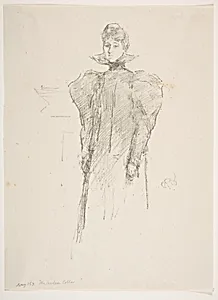
Medium
Transfer lithograph; only state (Chicago); printed in black ink on grayish ivory China paper
Dimensions
Image: 7 5/16 × 4 7/16 in. (18.5 × 11.2 cm) Sheet: 8 3/4 x 6 1/2 in. (22.3 x 16.5 cm)
Classification
Prints
Department
Drawings and Prints
Museum
Metropolitan Museum of Art, New York, NY
Credit
Gift of Paul F. Walter, 1985
Accession Number
1985.1161.15
Rights
Public Domain
Tags
Art Historical Context
James McNeill Whistler’s *The Medici Collar* (7) is a striking transfer lithograph, capturing a woman in elegant profile adorned with an elaborate, ruffled collar reminiscent of Renaissance fashion. Printed in black ink on delicate grayish ivory China paper this sole Chicago state measures just 7 5/16 × 4 7/16 inches, showcasing Whistler’s mastery of intimate scale. Housed in the Metropolitan Museum of Art’s Drawings and Prints department, reflects the artist’s late-career fascination with printmaking, a medium he championed for its directness and tonal subtlety. Whistler, a leading figure in the Aesthetic movement, prioritized harmony and suggestion over narrative, famously titling works with musical evocations like “Nocturnes” and “Harmonies.” Here, the transfer lithograph technique—transferring a drawing onto the stone for crisp lines—allowed his precise, calligraphic style to shine, evoking the refined portraits of 16th-century Italian nobility, such as those associated with the Medici family. This nod to historical elegance underscores Whistler’s cosmopolitan influences, blending Eastern paper finesse with Western portrait traditions. A gift to the Met from Paul F. Walter in 1985, this print highlights Whistler’s innovative editions, produced in limited runs for collectors. Its poised female subject invites viewers to ponder timeless beauty and the artistry of restraint, making it a gem for those exploring 19th-century graphic innovation.
About the Artist
James McNeill Whistler · 1834–1903
James Abbott McNeill Whistler (1834-1903) was an American-born painter and printmaker who became a leading figure in the Aesthetic Movement and pioneer of Tonalism and Japonisme. He revolutionized art by championing "art for art's sake" and treating paintings as visual equivalents of musical compositions, titling works as "arrangements," "harmonies," and "nocturnes" to emphasize formal qualities o...