
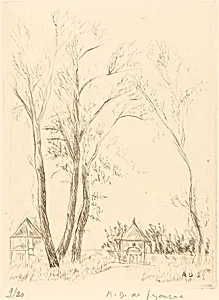
The Menagerie, Versailles (Small Plate) (Versailles, la Menagerie (petite planche))
Medium
etching
Classification
Department
CG-W
Museum
National Gallery of Art, Washington, D.C.
Credit
Frank Crowninshield Collection
Accession Number
1948.3.149
Rights
Public Domain
Art Historical Context
Visitors to the National Gallery of Art are invited to explore *The Menagerie, Versailles (Small Plate, a delicate 192 etching by French artist André Dunoyer deonzac. Part of the esteemed Frank Crowninshield Collection this print captures the ornate menagerie—an exotic animal enclosure—at the Palace of Versailles, the lavish royal residence built by Louis XIV in the th century. Segonz, a key figure in School of Paris, was renowned for his realist depictions of French landscapes and architecture, blending precise observation with a touch of decorative elegance. The menagerie, with its radial pavilions and aviaries, symbolized the Sun King's opulent display of power and global reach, housing rare beasts from afar. In 1924, amid the cultural recovery of post-World War I France, Segonzac's etching revives this Baroque splendor through the intimate "small plate" format, offering a closer, more personal gaze than grander views. Etching's intaglio technique—incising lines into a copper plate for inked impressions—allowed Segonzac to render intricate architectural details, subtle textures of stone and foliage, and atmospheric depth with masterful linework. This work exemplifies his printmaking prowess, bridging historical grandeur with modern artistry, inviting us to ponder Versailles' enduring allure.
About the Artist
André Dunoyer de Segonzac
André Dunoyer de Segonzac (1884–1974) was a leading French painter, draughtsman, engraver, and illustrator, born on 6 July in Boussy-Saint-Antoine near Paris, where he spent much of his childhood alongside time in the city. Defying his parents' initial hopes for a military career at Saint-Cyr, he pursued art, enrolling in 1900 at the École des Beaux-Arts in Paris as a general student. He studied u...