
The Miracle of Naim
Medium
Etching and aquatint; fourth state of four (Rieger)
Dimensions
Plate: 10 5/8 × 9 1/8 in. (26.3 × 23.2 cm) Sheet: 15 3/16 × 11 7/8 in. (38.5 × 30.2 cm)
Classification
Prints
Department
Drawings and Prints
Museum
Metropolitan Museum of Art, New York, NY
Credit
The Elisha Whittelsey Collection, The Elisha Whittelsey Fund, 1960
Accession Number
60.629.33
Rights
Public Domain
Tags
Art Historical Context
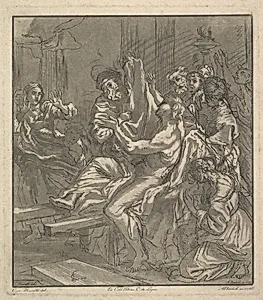
Behold *The Miracle of Naim (1786), a print in the Metropolitan Museum of Art Drawings and Prints department. Created by Adam von Bartsch an original composition by the Italian artist Carlo Maratti, this and aquatint depicts the biblical scene from the Gospel of Luke, where Jesus raises the widow's at the gate of Nain. Surrounded by figures of men and women—grieving mourners, astonished onlookers, and divine intervention—the work captures a moment of profound compassion and miracle, blending religious narrative with human emotion. The medium shines here: etching provides crisp lines for intricate details like flowing drapery and expressive faces, while aquatint adds rich, velvety tones, mimicking the painterly depth of Maratti's Baroque originals. This fourth state of four, as noted by cataloguer Rieger, represents the final, refined iteration, showcasing Bartsch's mastery as an 18th-century reproductive printmaker who popularized old master works for wider audiences. Printed on a modest plate (10 5/8 × 9 1/8 in.), it exemplifies how prints democratized art during the Enlightenment. Acquired through The Elisha Whittelsey Collection in 1960, this piece highlights the Met's commitment to preserving printmaking's technical evolution and cultural resonance, inviting visitors to ponder faith, loss, and wonder through a lens of exquisite craftsmanship.
About the Artist
Carlo Maratti|Adam von Bartsch · 1625–1713
Son of a Dalmatian father. Known as the last major Italian artist of the classical tradition, which had originated with Raphael. He created a grandiose and decorative style that was valued by his ecclesiastical patrons. Comment on works: History; Religious.