
The Miracle of Shravasti
Unknown Artist
7th–9th century
Medium
Terracotta
Dimensions
H. 5 5/8 in. (14.3 cm); W. 3 1/2 in. (8.9 cm); D. 1/2 in. (1.3 cm)
Classification
Sculpture
Culture & Period
Thailand · Mon-Dvaravati period
Department
Asian Art
Museum
Metropolitan Museum of Art, New York, NY
Credit
Gift of Michael Phillips and Juliana Maio, 2001
Accession Number
2001.770.3
Rights
Public Domain
Tags
Art Historical Context
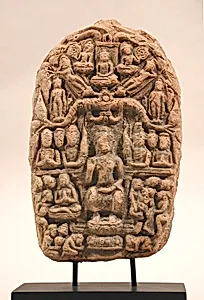
the city of Shravasti the Buddha once met a challenge from rival teachers who demanded visible proof of his powers. He rose into the air and multiplied his body into countless seated and standing figures, each one radiating the same calm authority, until the sky itself seemed filled with his presence and the doubters withdrew. The unknown Mon-Dvaravati sculptor compressed that moment onto a small terracotta plaque by crowding dozens of nearly identical Buddhas around two larger central figures. The dense layering of bodies and gestures creates an immediate sense of proliferation, while the slight differences in hand positions and postures keep the eye moving from one repeated form to the next. This seventh- to ninth-century relief, now at the Metropolitan Museum of Art, was likely made as a portable devotional object. Look at the lowest row of tiny seated figures whose hands rest in their laps; their quiet repetition shows how the miracle was understood to reach even the smallest worshipper.