
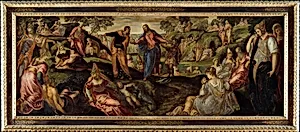
The Miracle of the Loaves and Fishes
ca. 1545–50
Medium
Oil on canvas
Dimensions
61 x 160 1/2 in. (154.9 x 407.7 cm)
Classification
Paintings
Department
European Paintings
Museum
Metropolitan Museum of Art, New York, NY
Credit
Francis L. Leland Fund, 1913
Accession Number
13.75
Rights
Public Domain
Tags
Art Historical Context
Step into the vibrant world ofopo Tintoretto'sThe Miracle of the Lo and Fishes* (ca. 1545–50), a monumental oil on canvas that captures one of Christ's most famous biblical miracles. From the New Testament, the scene depicts Jesus multiplying a few loaves and fishes to feed a vast crowd, surrounded by men, women,, and a sweeping landscape. At 61 x 160½ inches, this panoramic painting immerses viewers in the event's abundance and divine wonder. Created early in Tintoretto's in Venice, the work embodies the dramatic flair of Mannerism, a style he helped define alongside Titian and Veronese. Tintoretto's innovative techniques—elongated figures, dynamic compositions, and bold lighting—infuse the canvas with energy, transforming a familiar story into a theatrical spectacle. Oil on canvas allowed for rich colors and fluid brushwork, hallmarks of the Venetian Renaissance. Acquired by the Metropolitan Museum of Art in 1913 through the Francis L. Leland Fund, this piece highlights Tintoretto's mastery in blending spirituality with human drama. It's a testament to 16th-century Venice's artistic innovation, inviting us to ponder themes of faith, generosity, and the miraculous amid everyday life.