
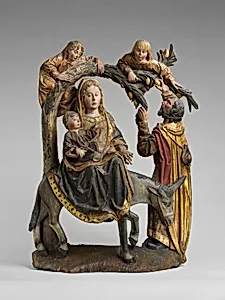
The Miracle of the Palm Tree on the Flight to Egypt
Unknown Artist
ca. 1490–1510
Medium
Walnut, gesso, paint, and gilding
Dimensions
49 3/4 × 36 1/2 × 10 1/2 in., 110 lb. (126.4 × 92.7 × 26.7 cm, 49.9 kg)
Classification
Sculpture-Wood
Culture
Spanish
Department
Medieval Art
Museum
Metropolitan Museum of Art, New York, NY
Credit
Rogers Fund, 1938
Accession Number
38.184
Rights
Public Domain
Tags
Art Historical Context
Nestled in the Medieval Art collection of the Metropolitan Museum of, *The Miracle of the Palm Tree on the Flight to* (ca. 1490–1510) is a Spanish wood sculpture that captures a tender moment from Christian apocryphal lore. This vivid scene depicts the Holy FamilyVirgin Mary cradling the Christ Child, Saint Joseph guiding their donkey, and attending angels—amid their perilous flight from King Herod into Egypt. Miraculously, a palm tree bends low at Mary's request, offering its fruit as divine refreshment, symbolizing God's providence and Mary's sanctity in late medieval devotion. Crafted from walnut with gesso, paint, and lavish gilding, the sculpture exemplifies Spanish late Gothic techniques, where intricate carving and polychromy brought biblical narratives to life in churches and homes. At nearly four feet tall and weighing 110 pounds, its monumental scale and rich surface details—flowing drapery, expressive faces, and shimmering gold—invited worshippers into the sacred story, blending realism with spiritual idealization during Spain's vibrant Renaissance transition. This anonymous work, acquired through the Rogers Fund in 1938, reflects the era's deep Marian piety and the cultural role of religious art in fostering faith among diverse audiences. Visitors today can marvel at its preserved vibrancy, a window into 15th-century Spain's artistic devotion.