
The Miser
c. 1861
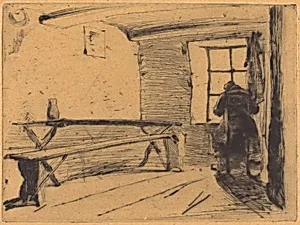
Medium
drypoint on wove tissue
Dimensions
plate: 11.75 x 15.88 cm (4 5/8 x 6 1/4 in.) sheet: 24.45 x 33.02 cm (9 5/8 x 13 in.)
Classification
Department
CG-W
Museum
National Gallery of Art, Washington, D.C.
Credit
Rosenwald Collection
Accession Number
1943.3.8445
Rights
Public Domain
Art Historical Context
James McNeill Whistler’s *The Miser* (c. 1861) is a masterful drypoint print that captures the artist’s innovative approach to printmaking during his early career in London. Whistler, an American expatriate renowned for his Aesthetic movement ideals—prioritizing “art for art’s sakeproduced this intimate work on a small plate measuring just 11.75 x 15.88 cm. The title evokes a solitary, miserly figure, rendered with Whistler’s characteristic subtlety and tonal finesse, reflecting his fascination with everyday subjects and Japanese-inspired simplicity. Drypoint, Whistler’s favored technique here, involves scratching directly into a copper plate with a sharp tool, raising a soft burr that yields velvety black lines and rich textures in the impression. Printed on delicate wove tissue paper (sheet: 24.45 x 33.02 cm), it showcases the medium’s potential for luminous depth and immediacy, distinct from the sharper lines of etching. Whistler experimented boldly with drypoint around this time, pushing editions to capture evolving burr effects, making each print unique. Housed in the National Gallery of Art’s Rosenwald Collection (Department CG-W), *The Miser* exemplifies Whistler’s pivotal role in elevating prints to fine art status. For visitors, it offers a window into 19th-century urban life and the artist’s quest for harmony between line, tone, and mood.
About the Artist
James McNeill Whistler · 1834–1903
James Abbott McNeill Whistler (1834-1903) was an American-born painter and printmaker who became a leading figure in the Aesthetic Movement and pioneer of Tonalism and Japonisme. He revolutionized art by championing "art for art's sake" and treating paintings as visual equivalents of musical compositions, titling works as "arrangements," "harmonies," and "nocturnes" to emphasize formal qualities o...