
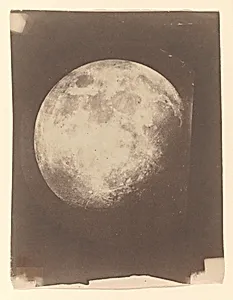
The Moon
Medium
Salted paper print from glass negative
Dimensions
Plate: 8 7/16 × 6 5/16 in. (21.4 × 16 cm) Sheet (approx.): 8 5/16 × 6 1/4 in. (21.1 × 15.8 cm)
Classification
Photographs
Department
Photographs
Museum
Metropolitan Museum of Art, New York, NY
Credit
Robert O. Dougan Collection, Gift of Warner Communications Inc., 1981
Accession Number
1981.1229.1
Rights
Public Domain
Tags
Art Historical Context
In the mid-19th century, as photography emerged as a revolutionary technology, John Adams Whipple James Wallace Black captured *The Moon* between 1857 and 1860. This salted paper, made from a glass negative measuring about 8½ × 6½ inches, showcases the lunar surface's craters and shadowed maria with remarkable clarity for its time. Housed in the Metropolitan Museum of Art's Robert O. Dougan Collection it exemplifies early astrophotography's blend of art and science. Whipple, a Boston daguerreotypist known for his precise portraits and scientific images, collaborated with Black, a fellow photographer, to push the boundaries of the medium. The salted paper process—coating paper with salt and silver nitrate—produced soft yet detailed tones, ideal for rendering the moon's ethereal glow from telescopic exposures. These prints were among the first to reveal the moon's topography to the naked eye, bridging astronomy and visual art. This work holds immense historical significance as a milestone in capturing celestial bodies photographically, predating space-age imagery by a century. It invited museum-goers and scholars alike to ponder humanity's place in the cosmos, turning a distant orb into an intimate, textured marvel.