
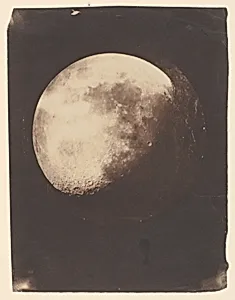
The Moon
Medium
Salted paper print from glass negative
Dimensions
Sheet: 8 1/4 × 6 3/16 in. (21 × 15.7 cm)
Classification
Photographs
Department
Photographs
Museum
Metropolitan Museum of Art, New York, NY
Credit
Robert O. Dougan Collection, Gift of Warner Communications Inc., 1981
Accession Number
1981.1229.19
Rights
Public Domain
Tags
Art Historical Context
Behold *The Moon* (1857–60), a pioneering salted paper print from glass negative by Boston photographers John Adams Whipple and James Black. Captured through a powerful telescope at Harvard College Observatory, this 8¼ × 6⅜-inch image reveals the lunar surface's craters and maria in stunning detail, marking one of the earliest successful astro-photographs. In the mid-19th century, was revolutionizing science and art. Whipple, renowned for his daguerreotypes and collaborations with astronomer William Cranch Bond, employed the wet-collodion process—coating glass plates with light-sensitive chemicals just before exposure—to create sharp negatives. These were contact-printed onto salted paper, a technique that produced rich tonal range but required precise timing before the emulsion dried, highlighting the era's technical ingenuity. Held in The Metropolitan Museum of Art's Robert O. Dougan Collection, this print bridges astronomy and visual artistry, inspiring wonder at the cosmos. It underscores photography's shift from portraiture to scientific documentation, forever changing how we visualize the heavens.