
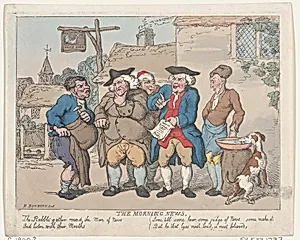
The Morning News
Medium
Hand-colored etching with stipple
Dimensions
Sheet: 6 5/8 × 8 3/16 in. (16.8 × 20.8 cm)
Classification
Prints
Department
Drawings and Prints
Museum
Metropolitan Museum of Art, New York, NY
Credit
The Elisha Whittelsey Collection, The Elisha Whittelsey Fund, 1959
Accession Number
59.533.1737
Rights
Public Domain
Tags
Art Historical Context
**The Morning News**, a hand-colored etching with stipple created around 1800 by British satirists Thomas Rowlandson and Henry William Bunbury, captures the humorous chaos of daily life in Regency England. Rowlandson, renowned for his witty caricatures poking fun at social follies, often collaborated with Bunbury, another master of exaggerated scenes. This print likely depicts men engrossed—or comically overwhelmed—by the morning newspaper, with dogs adding a layer of domestic mischief, as suggested by its tags. At just 6 5/8 × 8 3/16 inches, it was designed as an affordable, shareable commentary on the era's growing news obsession. The medium exemplifies early 19th-century printmaking innovation: etching provided sharp, expressive lines for Rowlandson's fluid figures, while stippling created subtle tones for depth and texture. Hand-coloring then brought vibrant life, making these satirical broadsheets popular among the middle class. Newspapers like *The Times* were booming, fueling public discourse on politics and scandal, which artists like Rowlandson lampooned to critique manners and masculinity. Housed in the Metropolitan Museum of Art's Elisha Whittelsey Collection, this work highlights satire's role in British culture, blending sharp observation with levity. It's a delightful window into how everyday rituals became fodder for laughter, reminding us that some morning routines never change!
About the Artist
Thomas Rowlandson|Henry William Bunbury · 1756–1827
Thomas Rowlandson (1757–1827) was an English artist and caricaturist whose satirical watercolors and prints captured the social life of Georgian Britain with unparalleled wit and technical mastery. Alongside James Gillray, he is recognized as one of the greatest British graphic artists, and his distinctive flowing line and keen observations have made his work integral to understanding late 18th an...