
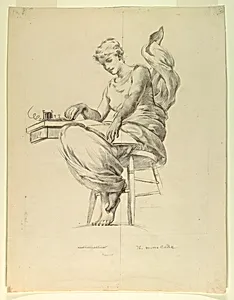
The Morse Code, Study for "Electricity as Applied to Commerce," Manufactures and Liberal Arts Building, World's Columbian Exposition, Chicago, IL
Classification
figures
Department
Smithsonian Collection
Museum
Smithsonian American Art Museum
Credit
Gift of J.Carroll Beckwith
Accession Number
1915-2-4
Rights
Public Domain
About this artwork
Research in Progress
Art Historical Context
J. Carroll Beckwith, a American painter trained in Paris and known for his elegant figure studies and portraits, created *The Morse Code* in 1891–92 as a preparatory sketch for a larger mural in Chicago's World's Columbian Exposition 1893. This event celebrated the 400th anniversary of Columbus's while showcasing America's industrial triumphs, with the massive Manufactures and Liberal Arts Building a centerpiece of innovation. Beckwith's work was destined for a panel titled *Electricity as Applied to Commerce*, capturing the era's fascination with telegraphy and Samuel Morse's revolutionary code. Classified among figure studies in the Smithsonian American Art Museum's collection—gifted by the artist himself—this piece likely depicts operators or symbols embodying the dawn of instant global communication. In the Gilded Age, electricity symbolized progress, linking commerce, manufactures, and the arts in ways that transformed society. As a study, it reveals Beckwith's meticulous process, blending academic precision with the exuberance of World's Fair spectacle. Though details like the medium remain under research, *The Morse Code* invites us to marvel at how art immortalized technology's spark, bridging human ingenuity across continents and time. A testament to American optimism on the cusp of the modern world.