
The mousetrap
Medium
Classification
Department
Smithsonian Collection
Museum
Smithsonian American Art Museum
Credit
Gift of Edmond C. Bonaventure
Accession Number
1951-90-2
Rights
Public Domain
About this artwork
Research in Progress
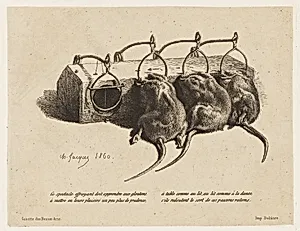
Art Historical Context
**The Mousetrap** (1860) is an evocative print by French artist Charles Émile Jacque (181–1894), a of rural scenes and animal studies. Jacque, a key figure in the Barbizon School alongside artists like Millet and Corot, drew inspiration from the French countryside near Barbizon, capturing the simplicity and grit of peasant life during the mid-19th century. amid France's Second Empire, when industrialization was transforming rural traditions, this work reflects the era's fascination with authentic, unidealized depictions of everyday existence. As a print—likely an etching, Jacque's favored technique—the artwork showcases his meticulous line work and tonal depth, allowing for intricate details in textures like fur, wood grain, or rustic interiors. These prints were affordable, democratizing art for a broader audience beyond oil paintings. The title hints at a humble domestic or farm scene, perhaps symbolizing human ingenuity or the cycle of survival in agrarian life, themes central to Jacque's oeuvre of over 1,400 etchings focused on poultry, livestock, and laborers. Housed in the Smithsonian American Art Museum through a gift from Edmond C. Bonaventure, **The Mousetrap** invites visitors to ponder the quiet poetry of 19th-century rural France, bridging fine art with the tactile world of printmaking. (198 words)