
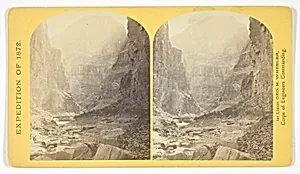
The mouth of Kanab Creek. The beds of the Colorado River and its tributary here lie in gorges cut by the running water to the depth of about 3.500 feet below the general surgace of the country. The highest point seen in the picture is 2.500 feet above the water, and the walls are here too steep to be scaled, No. 10 from the series "Geographical Explorations and Surveys West of the 100th Meridian"
1872
Medium
Albumen print, stereo
Dimensions
Each image: 9.3 × 7.4 cm (3 11/16 × 2 15/16 in.); Card: 9.9 × 17.7 cm (3 15/16 × 7 in.)
Classification
stereograph (albumen)
Department
Photography and Media
Museum
Art Institute of Chicago
Accession Number
210803
Rights
Public Domain
Art Historical Context
Captured in 1872 by William H Bell, *The Mouth of Kanab Creek* is a striking albumen stereograph from the series "Geographical Explorations and Surveys West of the th Meridian." This No. 10 image depicts the dramatic confluence of Kanab Creek and the Colorado River in what is now northern Arizona, where gorges plunge about 3,500 feet the surrounding plateau. The highest visible point towers 2,500 feet the water, with sheer walls too steep to scale—evoking the raw, impenetrable wilderness of the American Southwest. Bell, a photographer for Lieutenant George M. Wheeler's expeditions, used stereography to create a three-dimensional illusion when viewed through a stereoscope. This innovative 19th-century technique, paired with the albumen print process (coated with egg whites for sharp detail and rich tones), brought distant, hazardous terrains into parlors nationwide. At just 9.3 × 7.4 cm per image on a 9.9 × 17.7 cm card, these compact views fueled public awe and scientific interest in the post-Civil War era's push westward. Held in the Art Institute of Chicago's Photography and Media department, this work exemplifies documentary photography's role in mapping and mythologizing the frontier, blending artistry with exploration to immortalize nature's grandeur.