
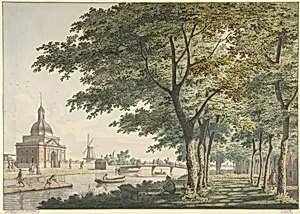
The Muiderpoort, Amsterdam, seen from the Plantage
1771
Medium
Black chalk, pen and brown and gray ink and watercolor.
Dimensions
10 x 14 5/16 in. (25.4 x 36.3 cm)
Classification
Drawings
Department
Drawings and Prints
Museum
Metropolitan Museum of Art, New York, NY
Credit
Harry G. Sperling Fund, 1991
Accession Number
1991.61
Rights
Public Domain
Tags
Art Historical Context
Step into 18th-century Amsterdam with Hendrick Keun's delicate drawing *The Muiderpoort, Amsterdam, seen from theage* (1771). intimate cityscape captures the newly constructed neoclassical Muiderpo gate—a grand entrance to the city built just a few years earlier by architect Abraham van der Hart—from the leafy Plantage district. Keun, a Dutch draughtsman known for his precise topographical views, renders the bustling scene with bridges arching over waterways, leafy trees framing the composition, boats gliding by, and distant windmills dotting the horizon, evoking the vibrant, watery heart of the Dutch Golden Age's enduring legacy. Crafted in black chalk, pen and brown and gray ink, and watercolor on paper (10 x 14 5/16 in.), the work showcases Keun's mastery of mixed media. The chalk provides soft, atmospheric shading, while fine pen lines define architectural details and organic forms, and subtle watercolor washes add depth and luminosity, mimicking the play of light on Amsterdam's canals. Such techniques were prized in 18th-century drawings for their portability and fidelity, serving as both artistic studies and records of urban transformation. Today, housed in the Metropolitan Museum of Art's Drawings and Prints department (acquired via the Harry G. Sperling Fund in 1991), this piece offers visitors a window into Amsterdam's evolving skyline. It highlights how artists like Keun preserved everyday wonders—gateways to trade and leisure—reminding us of the city's timeless blend of human ingenuity and natural beauty.