
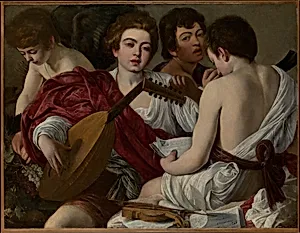
The Musicians
Medium
Oil on canvas
Dimensions
36 1/4 x 46 5/8 in. (92.1 x 118.4 cm)
Classification
Paintings
Department
European Paintings
Museum
Metropolitan Museum of Art, New York, NY
Credit
Rogers Fund, 1952
Accession Number
52.81
Rights
Public Domain
Tags
Art Historical Context
Step into the vibrant world of late 16th-century Rome with Caravaggio's *The Musicians* (1597), an oil-on-canvas masterpiece now housed in the Metropolitan Museum of Art. Painted when the artist, Michelangelo Merisi da Caravaggio, was just26, this work captures five young men in a casual gathering, immersed in music and merriment. Instruments like lutes and violins fill the scene, alongside a mischievous Cupid-like figure holding grapes, blending everyday revelry with mythological whimsy. Acquired through the Rogers Fund in 1952, it exemplifies Caravaggio's early Roman period, where he began revolutionizing European painting. Caravaggio's signature tenebrism—dramatic contrasts of light and shadow—brings the canvas to life, spotlighting the musicians' expressive faces and textured details against deep darkness. This oil technique allowed his unprecedented realism, rendering fabrics, skin, and fruits with tactile precision, influencing the Baroque movement's emphasis on emotion and naturalism over idealization. The half-length composition, intimate at 36¼ x 46⅝ inches, draws viewers into a moment of youthful camaraderie, reflecting Renaissance interests in music as a metaphor for harmony and the senses. Fun fact: The grapes symbolize indulgence, echoing classical themes of Bacchus, while the boys' direct gazes engage us as if we're joining the jam session. A pivotal piece in European paintings, *The Musicians* showcases Caravaggio's genius for elevating ordinary life to profound artistry.