
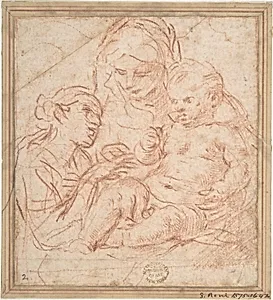
The Mystic Marriage of Saint Catherine
1612–48
Medium
Red chalk
Dimensions
4 11/16 x 4 1/4 in. (11.9 x 10.8 cm)
Classification
Drawings
Department
Drawings and Prints
Museum
Metropolitan Museum of Art, New York, NY
Credit
Gift of Cornelius Vanderbilt, 1880
Accession Number
80.3.331
Rights
Public Domain
Tags
Art Historical Context
In the intimate world of 17th-century Italian drawings, Simone Cantarini's *The Mystic Marriage of Saint* (c. 1612–48) captures a tender moment of spiritual devotion. Rendered in red chalk—a medium prized by Baroque artists for its warm, fleshy tones and subtle modeling—this small sheet (4 11/16 x 4 1/4 in.) likely served as a preparatory study. Cantarini, a Bolognese painter influenced by Guido Reni, infused his works with the dramatic elegance of the Baroque style, blending classical grace with emotional intensity. The scene depicts the iconic "mystic marriage," a visionary event in Catholic hagiography where the infant Christ places a wedding ring on Saint Catherine of Alexandria's finger, symbolizing her eternal betrothal to the divine. This motif, popular in Counter-Reformation art, emphasized mystical union and female sainthood, resonating with devotees amid religious fervor. Cantarini's delicate lines and soft shading highlight the figures' gentle interplay, evoking intimacy in a format suited for private contemplation or workshop use. Now housed in the Metropolitan Museum of Art's Drawings and Prints department, this gem entered the collection as a gift from Cornelius Vanderbilt in 1880. Its modest scale invites close viewing, revealing the artist's masterful touch in evoking sacred tenderness through humble chalk.
About the Artist
Simone Cantarini · 1612–1648
He was one of the most eminent pupils of Guido Reni and one of the most gifted engravers in the tradition of the Carracci. He had a strong personality and developed a highly original style, which united aspects of Bolognese classicism with a bold naturalism. Comment on works: Religious