
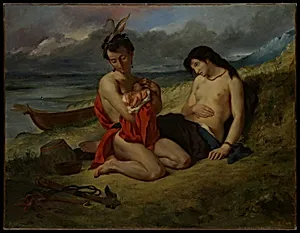
The Natchez
1823–24 and 1835
Medium
Oil on canvas
Dimensions
35 1/2 x 46 in. (90.2 x 116.8 cm)
Classification
Paintings
Department
European Paintings
Museum
Metropolitan Museum of Art, New York, NY
Credit
Purchase, Gifts of George N. and Helen M. Richard and Mr. and Mrs. Charles S. McVeigh and Bequest of Emma A. Sheafer, by exchange, 1989
Accession Number
1989.328
Rights
Public Domain
Tags
Art Historical Context
Eugène Delacroix'sThe Natchez* (1823–24 and 1835), an oil on canvas measuring 35½ × 46 inches, captures a poignant family moment among the Natchez, a Native American tribe from the Mississippi region. As a cornerstone of French Romanticism, Delacroix infused the work with emotional depth and vivid color, hallmarks of his style that broke from the rigid classicism of his time. He revisited and refined the painting over a decade, showcasing his dedication to evoking the nobility and tragedy of indigenous peoples. The scene tenderly portrays a father, mother, and infant—echoing Romantic ideals of familial bonds amid nature's grandeur. Inspired by early 19th-century accounts of the Natchez, whose society was devastated by colonial conflicts in the 1730s, Delacroix romanticizes their existence, presenting them as dignified figures in a lush, exotic landscape. This reflects the era's fascination with "noble savages" and critiques of European expansion. Delacroix's dynamic brushwork and rich palette create a sense of movement and light, drawing viewers into an intimate yet epic narrative. Housed in the Metropolitan Museum of Art's European Paintings department, *The Natchez* exemplifies how Romantic art bridged personal emotion with broader cultural commentary, inviting us to reflect on humanity's shared vulnerabilities.
About the Artist
Eugène Delacroix · 1798–1863
Eugène Delacroix (1798–1863) stands as the defining figure of French Romanticism and a pivotal bridge to modernism. Born in Charenton-Saint-Maurice near Paris, he came from distinguished lineage—his mother descended from the prestigious Oeben-Riesener furniture dynasty, while persistent speculation suggested the statesman Talleyrand may have been his biological father, a theory supported by physic...