
The Nativity
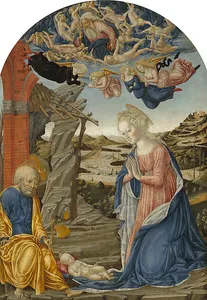
Medium
Tempera on wood
Dimensions
Overall 20 3/4 x 23 5/8 in. (52.7 x 60 cm); painted surface 20 1/2 x 22 1/2 in. (52.1 x 57.2 cm); painted surface of reassembled work 33 1/4 in. (84.5 cm) high at center
Classification
Paintings
Department
European Paintings
Museum
Metropolitan Museum of Art, New York, NY
Credit
The Metropolitan Museum of Art, New York. Gift of George Blumenthal, 1941. 41.100.2; National Gallery of Art, Washington, D.C. Samuel H. Kress Collection, 1952.5.8
Accession Number
41.100.2
Rights
Public Domain
Tags
Art Historical Context
Francesco di Giorgio Martini (1439–1501), a versatile Sienese Renaissance artist, architect, and theorist, crafted *The Nativity* ina on wood, a prized in 15th-century Italy for luminous detail and durability. Egg-based tempera allowed Martini to layer vibrant colors and fine lines, capturing the sacred birth of Jesus amid Virgin Mary, Joseph, angels and God the Father. intimate panel, measuring about 20¾ x 23⅝ inches overall, evokes the devotional art of Siena's workshops, where religious scenes like the Nativity inspired private prayer and public worship. The painting's slightly irregular dimensions—highlighting a reassembled painted surface rising to 33¼ inches at center—suggest meticulous conservation, preserving Martini's blend of Gothic elegance and emerging Renaissance naturalism. His style, influenced by contemporaries like Piero della Francesca, emphasizes harmonious figures and ethereal light, underscoring the Nativity's theological heart: divine incarnation amid humble shepherds. Housed in The Metropolitan Museum of Art (gift of George Blumenthal, 1941), with ties to the National Gallery of Art's Kress Collection, this work reflects the era's patronage of sacred imagery. Visitors will appreciate its quiet spirituality, a window into Renaissance Italy's fusion of faith, art, and humanism.
About the Artist
Francesco di Giorgio Martini · 1439–1501
Francesco di Giorgio Martini (1439–1501) was a quintessential Renaissance polymath from Siena, Italy, excelling as a painter, sculptor, architect, engineer, and theorist in the Sienese School tradition. Baptized on September 23, 1439, to a poultry dealer named Francesco Maurizio di Giorgio di Martino, his early life remains sparsely documented, with the first record of his artistic activity appear...