
The Nativity
1726 to 1750
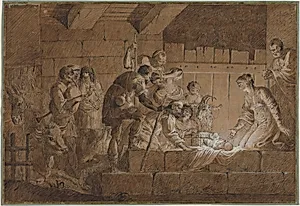
Medium
pen and black ink with brown wash, heightened withwhite, on (brown paper?)
Dimensions
overall: 29.8 x 44 cm (11 3/4 x 17 5/16 in.)
Classification
Drawing
Department
CG-E
Museum
National Gallery of Art, Washington, D.C.
Credit
Ailsa Mellon Bruce Fund
Accession Number
1972.32.1
Rights
Public Domain
Art Historical Context
Giuliano Traballesi’s “The Nativity,” drawn between 1726 and 1750, presents the familiar Christian scene of Christ’s birth in a quiet, intimate setting. The composition centers on the newborn child, Mary, and Joseph, surrounded by attending figures in a humble stable, inviting viewers to contemplate themes of humility and divine grace central to the holiday story. Executed in pen and black ink with brown wash, heightened with white on brown paper, the drawing measures just under 12 by 17 inches. This combination of media allows Traballesi to build rich tonal contrasts and luminous highlights, giving the figures a sculptural presence despite the work’s modest scale. Such techniques were prized in 18th-century Italy for both finished presentation drawings and preparatory studies. Acquired by the National Gallery of Art through the Ailsa Mellon Bruce Fund, the sheet offers a window into the working methods of artists in the mid-1700s, when ink-and-wash drawings often served as vital steps toward larger paintings or frescoes destined for churches and palaces.