
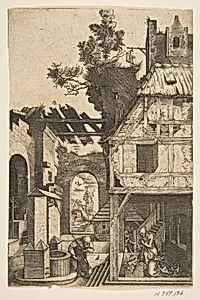
The Nativity (reverse copy)
n.d.
Medium
Engraving
Dimensions
Sheet: 6 7/8 × 4 9/16 in. (17.5 × 11.6 cm)
Classification
Prints
Department
Drawings and Prints
Museum
Metropolitan Museum of Art, New York, NY
Credit
Harris Brisbane Dick Fund, 1953
Accession Number
53.601.18(28)
Rights
Public Domain
Tags
Art Historical Context
Albrecht Dürer's *The Nativity (reverse)* is a captivating engraving that captures the sacred moment of Christ's birth, featuring the Virgin Mary, the infant Jesus, and attendant figures in a humble stable setting. Created by the renowned German Renaissance master around the late 15th or early 16th century (date not specified), this print exemplifies Dürer's extraordinary skill in elevating engraving from a reproductive medium to a fine art form. Measuring just 6 7/8 × 4 9/16 inches, its intimate scale invites close contemplation, much like a personal devotional object from the era. As a "reverse copy," this work likely derives from a counterproof—a technique where a damp printed sheet is pressed against another to produce a mirror-image impression, often used by artists like Dürer for study or transfer. Dürer's precise line work, with intricate cross-hatching for depth and texture, reflects his Northern Renaissance style, blending meticulous detail with emotional spirituality. Nativity scenes were central to Christian iconography, symbolizing humility and divine incarnation, and Dürer's versions circulated widely, making religious art accessible beyond elite patrons. Housed in the Metropolitan Museum of Art's Drawings and Prints department (Harris Brisbane Dick Fund, 1953), this piece highlights printmaking's role in the Renaissance cultural explosion, allowing masterpieces to reach a broad audience and influence generations of artists.
About the Artist
Albrecht Dürer · 1471–1528
Albrecht Dürer (1471–1528) stands as the preeminent figure of the Northern Renaissance and arguably the most influential artist in the history of printmaking. Born in Nuremberg on May 21, 1471, and dying in the same city on April 6, 1528, Dürer revolutionized the status of the artist in Northern Europe, transforming printmaking from a commercial craft into an independent fine art and establishing ...