
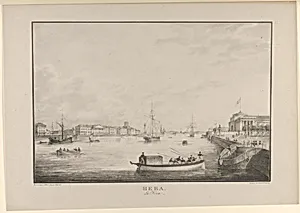
The Neva River
ca. 1800–1850
Medium
Lithograph
Dimensions
Image: 11 9/16 × 17 1/4 in. (29.3 × 43.8 cm) Sheet: 14 3/4 × 21 1/16 in. (37.4 × 53.5 cm)
Classification
Prints
Department
Drawings and Prints
Museum
Metropolitan Museum of Art, New York, NY
Credit
The Elisha Whittelsey Collection, The Elisha Whittelsey Fund, 1958
Accession Number
58.509.17
Rights
Public Domain
Tags
Art Historical Context
**The Neva River** by Karl Petrovich Brov captures the majestic flow of Russia's vital waterway through St. Petersburg in this evocative lithograph, dated around 1800–1850. Beggrov, a prominent Russian-German artist, specialized in detailed topographical views of the imperial capital, often highlighting its grand architecture and bustling river life. Here, the scene teems with boats gliding along the Neva, framed by stately buildings that evoke the city's nickname, the "Venice of the North." print's generous dimensions—image 11 9/16 × 17 1/4 inches—allow for an immersive panorama, inviting viewers to trace the river's path amid early 19th-century urban energy. Lithography, the medium of choice, revolutionized printmaking during this era by enabling artists like Beggrov to produce intricate, tonal images from greasy crayon drawings on stone. This technique democratized access to high-quality views, preserving St. Petersburg's evolving skyline for a wide audience. Produced during Russia's Romantic period under tsars like Alexander I and Nicholas I, the work reflects national pride in the city's neoclassical splendor and its role as a European cultural hub. Housed in the Metropolitan Museum of Art's Drawings and Prints department, thanks to The Elisha Whittelsey Collection (1958), **The Neva River** offers a window into imperial Russia's watery heart. It's a testament to how prints like this bridged art and documentation, blending beauty with historical record for generations of admirers.